

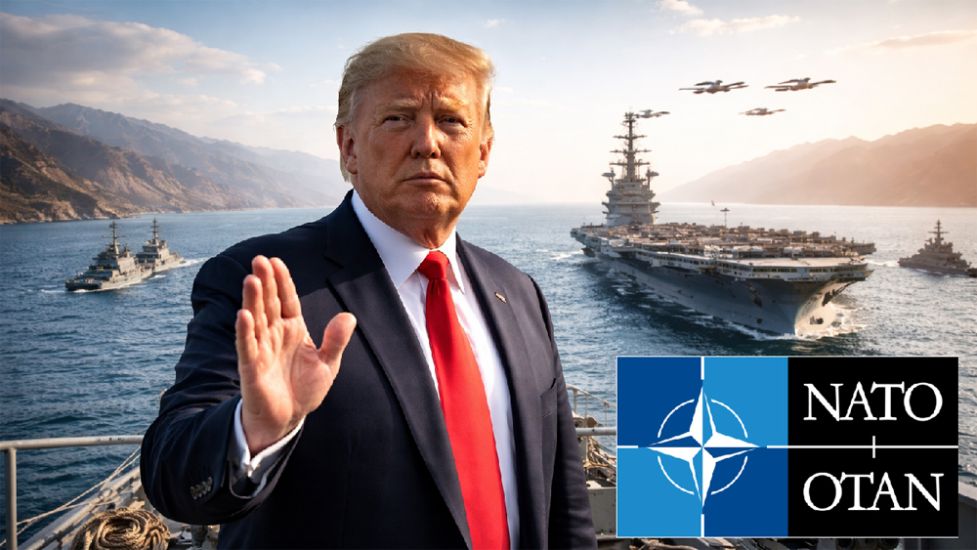
US President Donald Trump has called on allies to send warships to the Strait of Hormuz, one of the world's most important energy supply routes, to keep it safe. But that call has not received much response.
One country after another is rejecting his call. Now he has asked the Western military alliance NATO for a visible and specific commitment to help in this regard.
Two European diplomats told the British news agency Reuters this information on Thursday.
The report said NATO Secretary General Mark Rutte told officials in several alliance countries that US President Donald Trump "wants a visible and concrete commitment to help secure the Strait of Hormuz in the coming days."
Mark Rutte met with Donald Trump in Washington on Wednesday amid tensions within NATO over a war with Iran.
"We understand the discontent and frustration in Washington," one of the diplomats told Reuters. "But at no time before or after this war, the United States consulted with its allies."
Donald Trump has also hinted at this. He wrote on his social media account Truth Social, "None of them—not even our own people—are very disappointing; NATO doesn't understand anything unless pressure is applied."
Meanwhile, hours after the ceasefire took effect on Wednesday, Iran closed the Strait of Hormuz again, accusing the United States of violating the terms of the agreement. Tehran's message to Washington is that 'war' and 'ceasefire' cannot go on at the same time. One must choose one.
In an interview with the BBC on Thursday, Iranian Deputy Foreign Minister Saeed Khatibzadeh said the strait had been open for thousands of years until the US-Iran war. It is not part of any international waters and safe passage there depends on the "goodwill" of Iran and Oman. The strait will not be reopened unless the US "retreats from this aggression".
The Iranian deputy foreign minister is believed to have been referring to Israel's attack on Lebanon.
Journalist Nick Robinson asked if safe passage meant that Iran would not charge a fee to every ship passing through the strait, or threaten to blow up ships. In response, the Iranian minister said that Iran wanted the strait to remain "peaceful."
He added that Iran will abide by international norms and international law. Safe passage is a bilateral issue, and Iran will not accept the Gulf being “misused” by warships.
Meanwhile, analysis of ship tracking data from Marine Traffic showed that at least nine ships have passed through the strait since the ceasefire was announced on Tuesday night. These include two oil and chemical tankers.
Sylhetview24.com/SZ
 আইটি ল্যাব সলিউশন্স লি.