






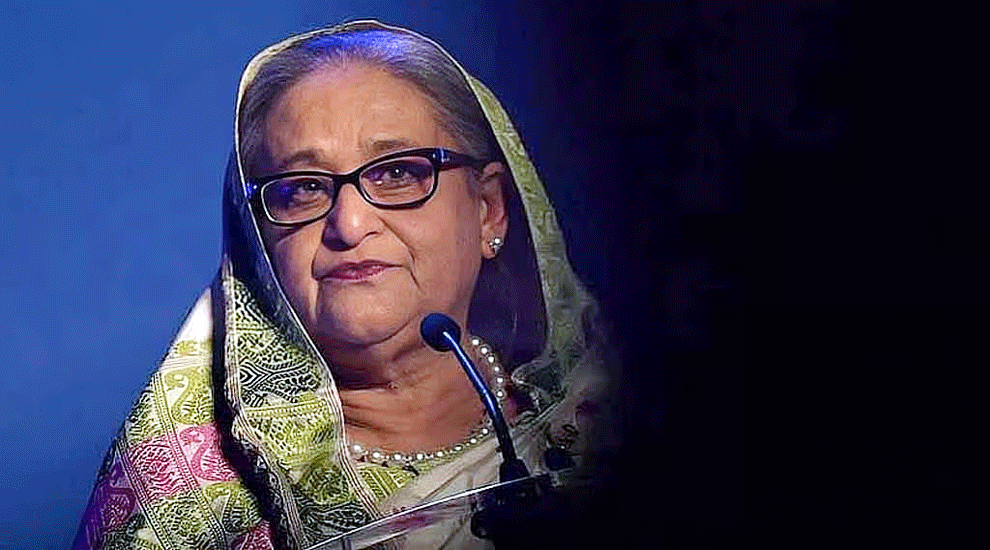


India is facing an increasingly difficult choice over Sheikh Hasina as it tries to balance its ties with the former prime minister against efforts to rebuild relations with Bangladesh, according to an analysis published by The Diplomat.
In a piece titled "India’s Sheikh Hasina Dilemma", analyst Jaideep Saikia argues that Hasina’s continued stay in India has left New Delhi facing significant costs, whichever course it takes.
Hasina has been living in India since she was ousted by the student-led mass uprising of July-August 2024.
Bangladesh has formally sought her extradition after she was sentenced to death in absentia for crimes against humanity linked to the July Uprising.
India has acknowledged receiving the request and says it is examining it under established legal and judicial procedures.
A Question of Credibility
Saikia describes the situation as the “Hasina dilemma” — a challenge that, in his view, cannot be resolved simply by choosing one side.
“It is a problem that cannot be solved simply by picking a side,” he writes, calling it “a masterclass in how personal diplomacy can trap a major power”.
The dilemma is rooted in a fundamental question of “credibility”, according to him.
Saikia noted that for 15 years, India’s foreign policy in its immediate neighbourhood rested on a “single, unwavering rule: keep Hasina stable, and India’s eastern border remains secure”.
There is a substantial security and connectivity history behind that argument.
After Hasina returned to power in 2009, Bangladesh security forces cracked down on northeastern Indian separatist groups that had operated from Bangladeshi territory, with several senior insurgent leaders eventually handed over to India.
Her government also expanded transit and connectivity arrangements with New Delhi. Bangladesh opened routes allowing Indian goods to move through its territory to the northeast, gave India access to Chattogram and Mongla ports, and developed new road and rail links, including the Maitree Setu and the Akhaura-Agartala railway.
Against that backdrop, Saikia says extraditing Hasina could raise questions among India's other regional partners about the durability of New Delhi’s support for longstanding allies.
"If India gives in to Dhaka’s demands and extradites Hasina to face a death sentence, it sends a dangerous signal to other neighbors like Bhutan, Nepal, and Sri Lanka: India will abandon its closest partners if the political winds change."
But keeping Hasina protected inside India comes at an equally high cost, according to the analyst.
That concern intersects with an already sensitive issue in bilateral ties.
"The strain on the relationship is no longer just quiet, back-channel friction; it has broken out into visible diplomatic boycotts."
Dhaka has objected to Hasina’s political activities from Indian soil while continuing to press for her extradition.
Bangladesh asked India in August to prevent Hasina from making political statements or conducting political activities from its territory, warning that such activity could undermine progress in bilateral relations.
Dhaka later said Hasina’s open press interaction in New Delhi had damaged efforts to create a favourable environment for Prime Minister Tarique Rahman to visit India.
A Wider Problem With Personal Diplomacy
The Hasina question is part of a broader problem with a foreign policy built too closely around one political leader.
It "serves as a systemic warning to foreign policy planners worldwide: never mistake a single political leader for an entire country", according to Saikia.
His criticism goes beyond the immediate extradition dispute.
Saikia says that by making Hasina so central to its Bangladesh policy, India failed to develop sufficiently deep relationships across the country’s broader political and civic landscape.
"By tying its national interests so tightly to one person, India failed to build deep institutional relationships with Bangladesh’s opposition parties, its student movements, and its wider civil society."
In his view, that has left New Delhi needing to rebuild political capital with Bangladesh’s new leadership while simultaneously dealing with what he calls the "political liability" of hosting Hasina.
"Because India did not engage with the broader political spectrum when it had the chance, it must now build diplomatic capital from scratch with a suspicious administration," he writes.
Shared Interests Remain
Saikia nevertheless argues that the relationship cannot remain paralysed because the two countries retain significant economic, geographic and security interests in one another.
"The relationship between India and Bangladesh cannot remain frozen in this defensive stance forever," he writes.
The economic ties remain substantial. Total bilateral trade stood at nearly $13 billion in the 2025-26 fiscal year, while India remains an important source of electricity for Bangladesh. Bangladesh, meanwhile, remains central to India’s transit, connectivity and security interests in its northeastern states.
The two countries have also continued discussing a possible visit by Tarique to India.
New Delhi says a bilateral invitation has been standing since Tarique took office, while Dhaka has said any visit would require an agreed agenda and a favourable environment.
Tarique did not attend this month’s BRICS Summit in New Delhi after Bangladesh objected to the way the summit invitation had been extended.
Dhaka said Tarique had been invited to the outreach session in his capacity as chairman of the Bay of Bengal Initiative for Multi-Sectoral Technical and Economic Cooperation (BIMSTEC), rather than as prime minister of Bangladesh. It nevertheless left open the possibility of a separate bilateral visit if the conditions were right.
A Possible Way Out
Saikia proposes two broad steps to move beyond the impasse.
The first is to find a third country willing to provide Hasina permanent asylum.
Under his proposal, India would avoid directly extraditing Hasina to Bangladesh, while her departure from Indian territory could remove one of the most politically sensitive issues weighing on bilateral ties.
He suggests India should seek to relocate her "to a secure country outside South Asia, such as in the Middle East or parts of Europe".
There is no public indication that India, Bangladesh or any third country is considering such an arrangement.
His second proposal is for the two countries to move towards "transactional institutionalism".
"Both capitals must agree to treat critical issues – like the upcoming December 2026 Ganga Water Sharing Treaty deadline – as technical, non-negotiable economic necessities rather than emotional political weapons."
The 30-year Ganges Water Sharing Treaty, signed on Dec 12, 1996, is due to expire on Dec 12 this year. Bangladesh and India have already begun discussions over its renewal, including through the Joint Rivers Commission.
Saikia believes the relationship has already changed fundamentally from the close personal ties of the Hasina years.
"Bangladesh-India relations will likely never return to the close, personal alliance of the past decade. The relationship has permanently shifted into a cooler, more transactional reality.
"Even so, if both New Delhi and Dhaka can successfully separate their internal political speeches from their shared geographic realities, they can prevent the presence of a single deposed leader from turning a temporary diplomatic crisis into a long-term regional disaster," he concludes.
Sylhetview24/SD