






ছবি: সংগৃহিত


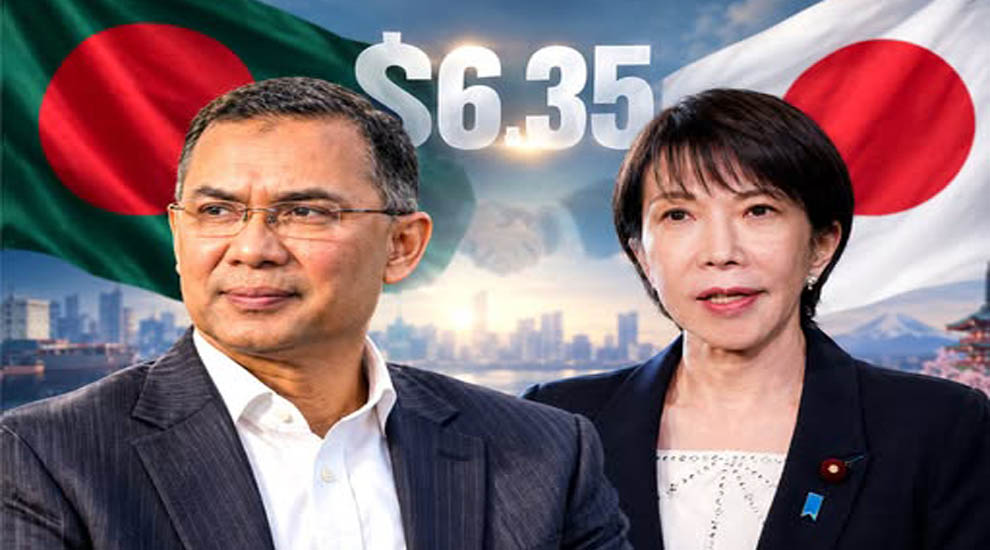
Bangladesh and Japan foresee a potential influx of up to one trillion Japanese Yen in Japanese private sector investment into Bangladesh over the next five years, aimed at creating 200,000 new jobs. Prime Minister of Bangladesh Tarique Rahman and Prime Minister of Japan Sanae Takaichi agreed to deepen bilateral economic and strategic ties during high-level talks.
The commitment was formally highlighted in a joint statement released on Tuesday (October 27, 2026) following a bilateral summit between the two leaders in Tokyo. The joint declaration reaffirmed both nations' resolve to elevate Bangladesh-Japan relations into a broader, highly effective strategic partnership, placing special emphasis on trade, investment, defense, energy security, infrastructure, agriculture, and information technology.
Expanding 'BIG-B' and Mega Infrastructure Projects
The two heads of government agreed to expand the 'Bay of Bengal Industrial Growth Belt' (BIG-B) initiative. Under this framework, both nations will accelerate the development of the Matarbari-Moheshkhali region as an integrated hub encompassing a deep-sea port, energy terminals, and industrial sectors. Additionally, cooperation will focus on finalizing operational readiness for the Third Terminal at Dhaka’s Hazrat Shahjalal International Airport and further modernizing Dhaka’s mass transit networks.
Energy Security and Financial Support
Prime Minister Tarique Rahman expressed gratitude to Tokyo for providing an emergency loan assistance of 50 billion Yen under Japan’s 'Power Asia' initiative, designed to stabilize Bangladesh’s economy and bolster energy supply chain security. The leaders also agreed to scale up renewable energy cooperation to bridge the supply-demand deficit.
Key Agreements and Defense Cooperation
The summit welcomed several key bilateral pacts and Memoranda of Understanding (MoUs):
Economic Cooperation: An MoU signed between Japan’s Ministry of Economy, Trade and Industry and Bangladesh's Economic Relations Division (ERD).
Agri-Sector Partnerships: Two MoUs executed with Japan’s Ministry of Agriculture, Forestry and Fisheries to modernize Bangladesh’s agriculture, food processing, and livestock sectors.
Climate Action: A Letter of Intent (LoI) focused on low-carbon development, energy efficiency, and expanding clean energy technologies.
Defense Transfers: Both leaders welcomed the operationalization of the agreement on the transfer of defense equipment and technology. As part of Japan’s Official Security Assistance (OSA), Tokyo confirmed the handover of one large patrol vessel and five maritime patrol craft to strengthen Bangladesh's coastal surveillance.
Furthermore, both leaders called for the swift implementation of the Bangladesh-Japan Economic Partnership Agreement (EPA) to navigate Bangladesh's upcoming graduation from Least Developed Country (LDC) status. The summit concluded with mutual pledges to enhance skilled labor deployment, foster educational exchanges, and pursue a durable, safe, and dignified repatriation solution for the Rohingya refugees to Myanmar.
Sylhetview24/RiK