






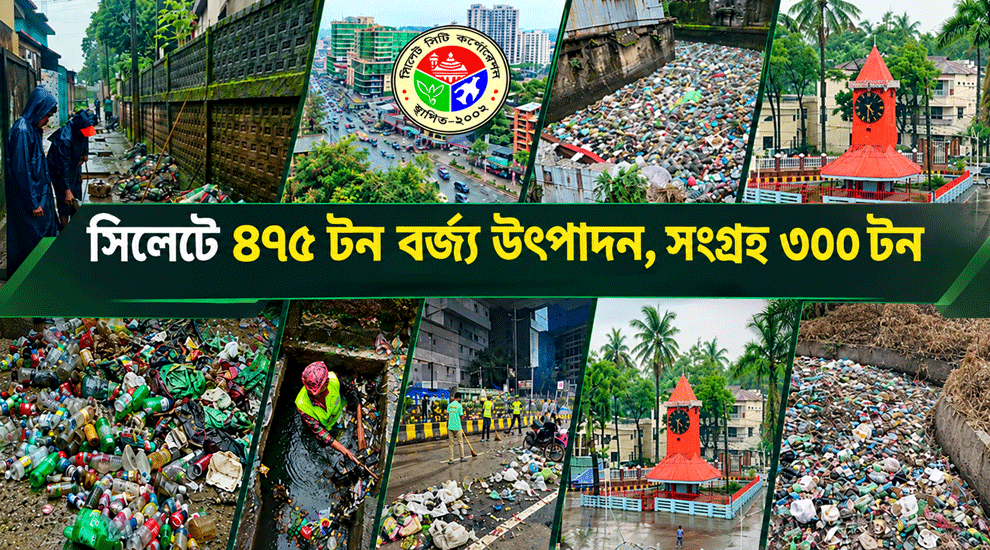


Out of the 475 tons of solid waste generated daily across Sylhet City Corporation (SCC) area, only 300 tons reach official collection vans, leaving 175 tons completely unaccounted for. This massive deficit—representing nearly 37 percent of total daily waste—is routinely dumped into drains, open lots, and the Surma River, triggering a severe environmental threat. Simultaneously, SCC is incurring an annual operational loss of BDT 12.25 crore in its sanitation department alone.
Chief Waste Management Officer of SCC, Mohammad Eklim Abdin, confirmed that no direct cleaning fees are collected from residents. Revenue is generated solely from commercial establishments and healthcare facilities, yielding BDT 2.25 crore annually, compared to BDT 14.50 crore spent strictly on sanitation workers' salaries. This disparity leaves a net yearly deficit of BDT 12.25 crore.
The 175-Ton Paradox and Marine Pollution
According to SCC assessments, while small portions of the uncollected waste are gathered by informal ragpickers or buried locally, the vast majority accumulates in urban drainage channels. Consequently, between 1 to 1.5 tons of non-biodegradable plastic waste flows into the Surma River every day, causing irreversible degradation to the riverbed ecosystem.
Overloaded Lalmatia Dump & Underutilized MRF Plant
The 300 tons of daily collected waste are transported to the Lalmatia Dumping Ground in South Surma, the city's sole landfill site. Accumulations at the site have surpassed 100,000 tons. Notably, SCC has yet to conduct a feasibility or capacity lifespan study for this open-air dumping ground.
Furthermore, although a Material Recovery Facility (MRF) plant with a processing capacity of 1,000 tons per day exists at Lalmatia, 85 percent of its infrastructure remains idle. The plant processes only 150 tons daily, extracting 50 tons of plastic waste for delivery to the LafargeHolcim Bangladesh cement factory in Chhatak—a supply arrangement that yields no financial returns for SCC.
Equipment Shortages & Forward Strategy
Of the 60 heavy dump trucks deployed for waste transit, 5 to 10 are consistently out of service due to mechanical faults. Moreover, against a citywide requirement of 1,000 trolley vans, only 500 to 600 are currently operational, severely impeding collection coverage in newly incorporated city wards with narrow road networks.
To address these vulnerabilities, SCC stated that public awareness campaigns are underway alongside preliminary plans to establish a sewage treatment plant and a modern Waste-to-Energy project in the future.
Sylhetview24/RiK/SD